AI Workflows
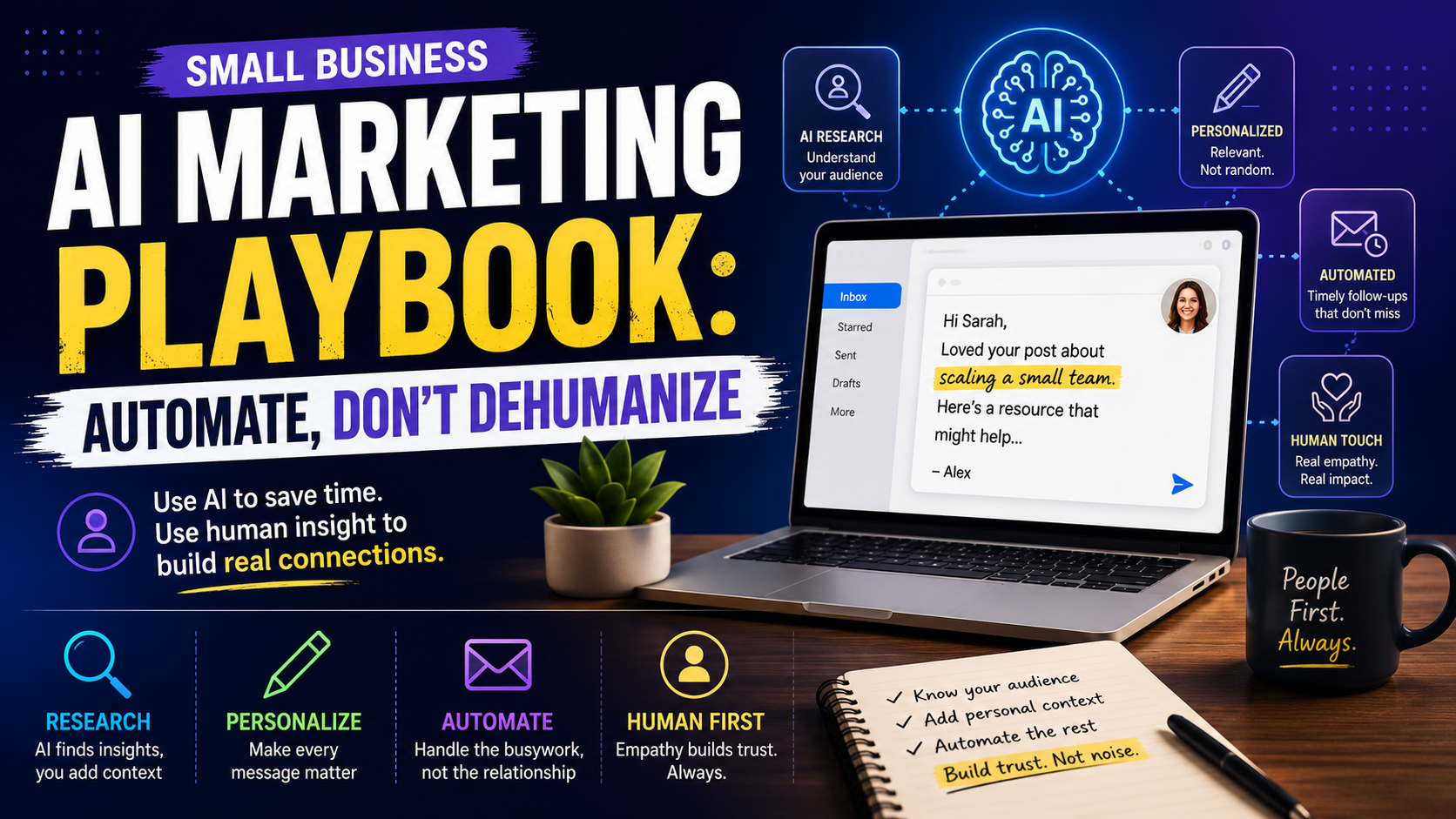
Small Business AI Marketing Playbook: Automate, Don’t Dehumanize
Learn how to build an AI marketing system for your small business that saves time and keeps your outreach personal. A practical 5-step playbook with real examples and mistakes to avoid.
Quick Take
Built for founders, operators, and lean teams who want practical guidance instead of vague advice.
Context – Why AI Marketing Feels Impersonal (and How to Fix It)
Most small business owners who try AI marketing tools give up within three weeks. Not because the tools fail, but because the output sounds hollow. Prospects can tell when a message was assembled by a machine, and that recognition erodes trust faster than a typo ever could.
The promise of AI in marketing is real. It can save hours of repetitive work, surface insights buried in customer data, and help you reach more people without hiring a full-time marketer. But the execution determines whether your outreach reads like a personal note from a real human being or like a mass-mailing from a call centre. This playbook gives you the system to get the efficiency without sacrificing the authenticity.
The Real Problem: Templates Without Context
Generic AI-generated marketing fails for one reason: it applies a template to a situation that demands context. When you ask an AI tool to “write a follow-up email to a prospect who downloaded my pricing guide,” it produces grammatically correct language that lacks any knowledge of who that prospect is, what they care about, or why they opened your guide in the first place. The result is a message that feels like boilerplate, because it is.
The fix is not to abandon AI. It is to change how you use it. AI works best as a research assistant and formatting tool, not as a ghostwriter making decisions about tone, timing, and relevance. Those decisions stay with you.
When Automation Backfires (A Concrete Example)
A local accounting firm I worked with decided to automate their tax-season outreach. They fed a list of past clients into a tool that generated personalized emails mentioning each client’s name, business type, and previous year’s tax situation. The output looked good on paper. But because the AI had no access to client conversations or context, one email congratulated a business owner on “another great year of growth” — a client whose company had lost two major contracts and was struggling to stay afloat. The client withdrew their business within a week.
That example illustrates the fundamental rule: AI can assemble data, but it cannot read a room. Every automated message should pass through a human who knows the relationship history before it lands in a customer’s inbox.
Strategy – The Three Zones of AI-Assisted Outreach
Rather than treating AI as a single tool that writes everything, break your marketing workflow into three distinct zones. Each zone assigns AI a different role with clear boundaries.
Zone 1: Research & Personalization (AI as Researcher, Not Writer)
In this zone, AI helps you gather and organize information about your prospects and customers. Feed it public data sources, your CRM notes, or call transcripts (with permission) and ask it to identify patterns, surface common questions, or flag opportunities. The output is a briefing document, not a draft message. You take that raw material and decide what matters.
For example, a consultant in the UK used AI to scan meeting notes from her last ten discovery calls. The AI extracted the three questions that came up most frequently. She then wrote a short email series addressing each question directly. AI handled the analysis. She handled the messaging.
Zone 2: Drafting & Variations (AI as Assistant, Not Author)
Once you know what you want to say, use AI to generate variations of your message. Write the first version yourself — even if it is rough. Then ask AI to rephrase it for different channels (email, LinkedIn, SMS) or different audience segments. You remain the editor-in-chief. You delete anything that sounds like generic corporate speak, such as “I hope this message finds you well” or “Looking forward to connecting.” These phrases signal automation and reduce reply rates.
Zone 3: Scheduling & Follow-Up (AI as Operator, Not Manager)
This zone handles the mechanics: sending messages at optimal times, tracking opens, and triggering follow-up reminders. AI can manage the calendar and queue so you do not have to. But it should never decide whether a follow-up is appropriate. That judgment call needs a human who understands the nuance of a delayed reply, a tough quarter, or a personal milestone. AI operates the system. You manage the relationships.
Workflow – Building Your Daily AI Marketing System
The following five-step workflow gives you a repeatable process for creating AI-assisted marketing that stays personal. Each step builds on the previous one, so do not skip ahead.
Step 1: Source Your Raw Material
AI needs context to produce useful outputs. Collect the raw material your messages will draw from: notes from sales calls, customer support tickets, FAQ documents, product usage data, and feedback surveys. Store these in a single searchable location. Without this foundation, every AI-generated message will be generic.
Step 2: Generate Personalization Hooks with AI
Take your raw material and ask AI to identify specific hooks you can use in your outreach. A hook might be a problem a customer mentioned, a goal they shared, or an industry trend that affects their business. Do not ask AI to write the full message at this stage. Ask it for bullet points or short phrases. You will turn those into natural language.
Step 3: Create Campaign Templates That Preserve Your Voice
Build templates that contain your brand’s cadence and word choices. Write a three-sentence tone example — the way you would greet a new prospect, the way you would thank a repeat customer, the way you would ask for a referral. Embed that example in your AI prompts so the tool mimics your voice instead of machine-default language. Test the template on a colleague before using it on a real contact.
Step 4: Set Up Automated Sequencing (With Human Review Gates)
Automation saves time, but only if you insert review points at critical stages. Configure your sequence to pause before the first follow-up, before any message that mentions sensitive information, and before any offer or pricing change. The AI sends the initial touchpoints. You approve the rest. This adds minutes to the process and prevents the kind of disaster described earlier.
Step 5: Measure Engagement, Not Just Delivery
Tracking open rates and click-throughs gives you a partial picture. Measure reply rates, sentiment in responses, and whether customers reference your messages in later conversations. If reply rates drop below 10 percent, your messaging has become too generic. If customers mention feeling “spammed,” you have lost the human touch. Engagement metrics tell you when to recalibrate.
Implementation Steps – From Zero to First Campaign in 5 Days
You can set up this system in a single working week. Use the following five-day plan to launch your first AI-assisted campaign.
Day 1–2: Audit Your Current Outreach and Identify Bottlenecks
Review the last 20 messages you sent to customers and prospects. Mark which ones required personal research, which ones used templates, and which ones generated a reply. Calculate how much time each message took to create. Your goal is to identify the steps that consume the most time without adding personalization value. That is where AI can help.
Day 3: Build a Personalization Brief for Your Ideal Customer
Create a one-page document that describes your ideal customer’s typical challenges, goals, and communication preferences. Include specific phrases and references that resonate with them. This brief becomes the foundation for all your AI prompts. Without it, your prompts will lack direction.
Day 4: Create 3 Reusable AI Prompts With Your Brand Tone Embedded
Write three prompts you will reuse for different scenarios: an introductory outreach, a follow-up after a meeting, and a re-engagement message for inactive customers. Each prompt should include your three-sentence tone example, the personalization brief from Day 3, and explicit instructions to avoid generic phrases. Test each prompt with a mock contact before using it live.
Day 5: Launch a Small Test Round (20 Contacts Max) and Review
Send your campaign to no more than 20 contacts. Monitor replies closely. Note which messages prompted responses and which ones felt flat. Adjust your prompts based on what you observe. Scale only after you achieve a reply rate above 15 percent on the test round.
Mistakes to Avoid When Automating Small Business Outreach
Even with a solid system in place, certain missteps can undermine your efforts. Watch for these three patterns.
Mistake 1: Letting AI Write the First Draft of Every Message
When AI writes the first draft, you default to its voice rather than yours. You may edit the output, but the structure and phrasing will always carry the tool’s imprint. Write your own first draft — even if it is messy — and use AI only for variations and formatting. Your authentic voice matters more than speed at the drafting stage.
Mistake 2: Ignoring Reply Cadence — AI Can’t Read the Room
A contact who replies with two words (“Thanks, maybe later”) signals something different from someone who says “Not now, check back in Q3.” AI treats both as “interested but not ready.” A human knows that the first reply might mean “stop emailing me,” while the second one is a genuine door left open. Set your system to flag all replies for human review rather than automatically scheduling follow-ups.
Mistake 3: Over-Optimizing for Speed Instead of Relevance
It is tempting to trim every manual step to save minutes. But the fastest system in the world produces nothing if the messages it sends get ignored or deleted. Prioritize relevance over speed. A message that takes ten minutes to research and write but generates a conversation is worth more than ten messages that take one minute each and produce zero replies.
Measurable Next Actions – Your 30-Day AI Marketing Check-In
After one month of using this system, evaluate your results against three specific metrics. Adjust your approach based on what the numbers tell you.
Metric 1: Reply Rate (Aim for >15% on Personalized vs Generic)
Compare the reply rate of your AI-assisted messages to your previous outreach methods. If personalized messages fail to outperform generic ones by a significant margin, your personalization is not deep enough. Revisit your raw material and your personalization hooks.
Metric 2: Time Saved Per Week (Track Before/After)
Measure how many hours you spent on marketing outreach before and after implementing this system. If you save less than two hours per week, your workflow still has too many manual steps. Look for additional areas where AI can handle research or formatting without touching tone or judgment.
Metric 3: Customer “Surprise & Delight” Mentions
Track how often customers mention that a message felt personal, thoughtful, or timely. These qualitative signals are harder to measure but more valuable than open rates. They indicate that your system is actually preserving the human element rather than just simulating it.
One-Week Review: Delete Over-Automated Sequences That Feel Cold
At the end of your first week of live campaigns, review every sequence in your system. Delete any automated step that adds speed but subtracts warmth. A sequence that sends five follow-ups in seven days may generate more touches, but it will also generate more unsubscribes. Keep only the steps that serve the relationship, not just the metrics.
Building an AI marketing system that saves time without dehumanizing your outreach is not about finding the perfect tool. It is about drawing clear boundaries between what the machine handles and what only you can decide. Research, formatting, and scheduling belong to the AI. Tone, judgment, and relationship awareness belong to you. Keep those lines intact, and your marketing will scale without losing its soul.
Keep Reading
Related stories from the same editorial lane
AI Workflows
Process Mapping Explained
process mapping explained. This playbook provides a clear, practical framework for mapping your marketing processes, enabling you to identify automation...
AI Workflows
Founder’s Playbook: AI Workflows That Scale
Founders: Get a step-by-step framework to design AI workflows that scale, automate busywork, and free up time. No hype—just practical steps.